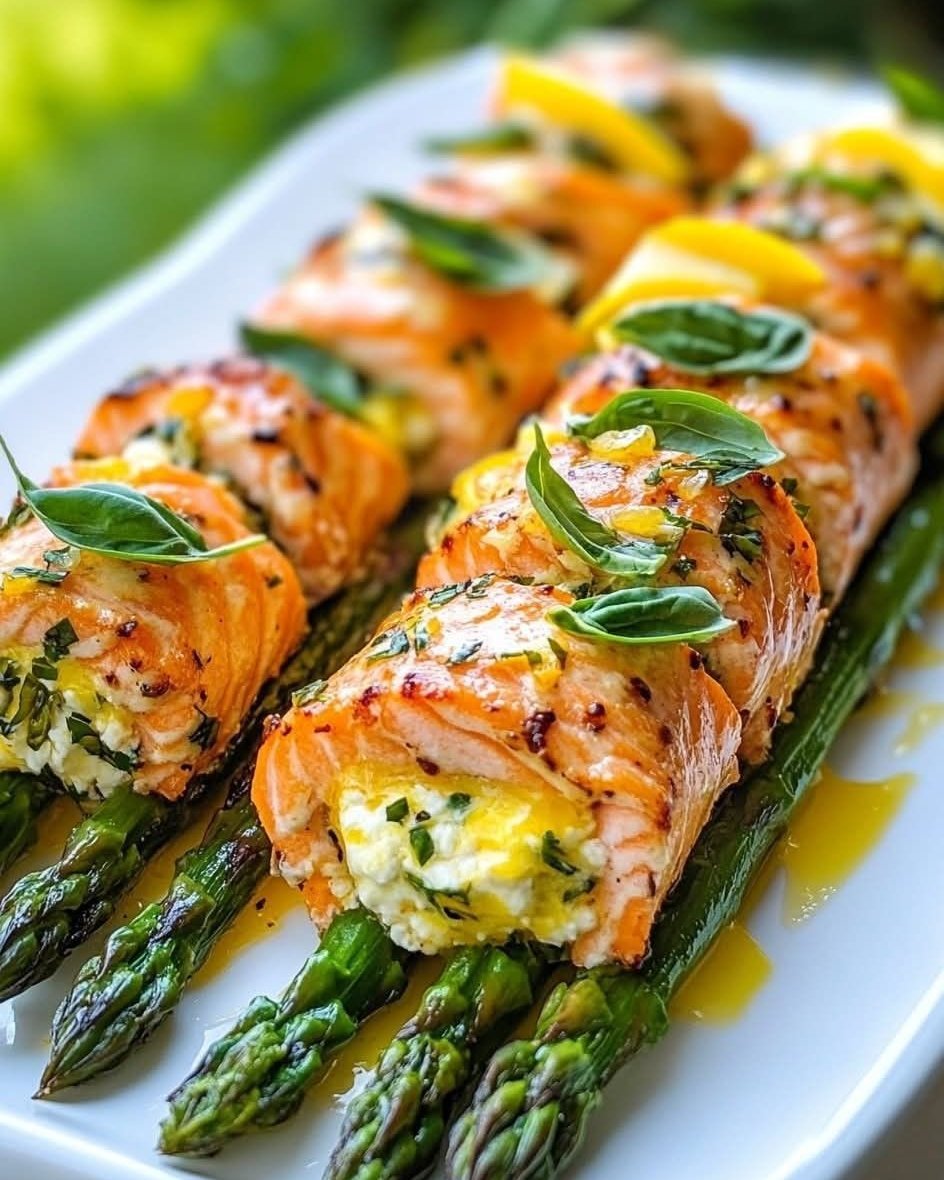
Yield: 4 servings
Prep Time: 25 minutes
Cook Time: 20 minutes
Total Time: 45 minutes
Difficulty: Moderate ⭐⭐⭐☆☆
Category: Main Course, Pescatarian
Cuisine: Modern Mediterranean
Ingredients
For the Salmon Rolls:
-
4 skinless, center-cut salmon fillets (about 6 oz / 170g each, 1-inch thick)
-
1 tsp olive oil
-
1 small shallot, finely minced
-
2 cups fresh baby spinach, roughly chopped
-
½ cup crumbled feta cheese
-
¼ cup cream cheese, softened
-
1 tbsp fresh dill, chopped
-
1 tsp lemon zest
-
Salt and freshly ground black pepper
-
4 pieces of kitchen twine (about 8 inches each)
For the Lemon-Dill Cream Sauce:
-
¾ cup heavy cream or full-fat coconut milk for a dairy-free alternative
-
2 tbsp fresh lemon juice
-
1 tbsp Dijon mustard
-
2 tbsp fresh dill, finely chopped
-
Salt and white pepper to taste
For Serving (Optional):
-
Lemon wedges
-
Steamed asparagus or roasted baby potatoes
-
Extra fresh dill for garnish
Instructions
Step 1: Prepare the Salmon Fillets
Using a very sharp knife, place a salmon fillet on a cutting board. Holding the knife parallel to the board, carefully slice horizontally through the center of the thickest part of the fillet, stopping about ½ inch from the opposite edge, to butterfly it open like a book. Repeat with the remaining fillets. Place each butterflied fillet between two sheets of plastic wrap or parchment paper. Gently pound with a rolling pin or meat mallet until uniformly ¼-inch thick. Season both sides lightly with salt and pepper.
Step 2: Make the Filling
-
In a small skillet over medium heat, warm the olive oil. Add the minced shallot and cook for 2-3 minutes until softened and fragrant.
-
Add the chopped spinach and a pinch of salt. Cook, stirring, until the spinach is completely wilted, about 2 minutes. Transfer the mixture to a medium bowl and allow it to cool for 5 minutes.
-
To the cooled spinach, add the crumbled feta, softened cream cheese, 1 tbsp dill, and lemon zest. Mix until well combined. Season with a crack of black pepper. The filling should hold together when pinched.
Step 3: Assemble the Rolls
-
Lay a pounded salmon fillet on a clean surface. Spoon one-quarter of the filling (about 3 tablespoons) onto the center of the fillet, shaping it into a log along the shorter end.
-
Carefully roll the salmon tightly around the filling, starting from the end with the filling. The seam should end up on the bottom.
-
Secure the roll with a piece of kitchen twine tied around the middle. Repeat with the remaining fillets and filling.
-
Place the rolls seam-side down on a plate, cover, and refrigerate for 15 minutes while you preheat the oven. This helps them hold their shape.
Step 4: Bake the Rolls
Preheat your oven to 400°F (200°C). Place the secured salmon rolls in a lightly greased baking dish, leaving a little space between them. Bake for 18-20 minutes, or until the salmon is opaque throughout and flakes easily with a fork.
Step 5: Prepare the Sauce
While the salmon bakes, make the sauce. In a small saucepan over medium-low heat, combine the heavy cream, lemon juice, and Dijon mustard. Whisk constantly until the mixture is warm and slightly thickened, about 5-7 minutes. Do not let it boil vigorously. Remove from heat and stir in the chopped dill. Season to taste with salt and white pepper. Cover and keep warm.
Step 6: Serve
-
Once baked, carefully transfer the salmon rolls to a cutting board and let them rest for 2-3 minutes. Gently remove the kitchen twine.
-
Spoon a pool of the warm lemon-dill sauce onto each plate. Place a salmon roll in the center of the sauce.
-
Garnish with extra fresh dill and a lemon wedge. Serve immediately with your chosen sides.
Chef’s Notes & Tips
-
Knife Skills: A sharp, flexible fillet knife is ideal for butterflying the salmon. Take your time and use a gentle sawing motion.
-
Filling Variations: Substitute the spinach with sautéed kale or finely chopped artichoke hearts. Swap feta for goat cheese or ricotta.
-
Make-Ahead: You can assemble the rolls (through step 3) up to 24 hours in advance. Store them covered in the refrigerator until ready to bake. You may need to add 2-3 minutes to the baking time.
-
Don’t Overcook: Salmon is best when still slightly moist in the very center. It will continue to cook slightly while resting.
-
Sauce Consistency: If your sauce seems too thin, let it simmer a minute longer. If it’s too thick, whisk in a teaspoon of water or lemon juice.
Nutrition Information (Per Serving, includes sauce)
-
Calories: 545 kcal
-
Total Fat: 40g
-
Saturated Fat: 20g
-
-
Cholesterol: 185mg
-
Sodium: 480mg
-
Total Carbohydrates: 6g
-
Dietary Fiber: 1g
-
Sugars: 3g
-
-
Protein: 38g