| Prep Time | Cook Time | Total Time | Intensity | Yield |
|---|---|---|---|---|
| 20 minutes | 25-30 minutes | 2 hours 15 minutes | Intermediate | 8 bagels |
Ingredients
For the Dough:
-
1 cup (240g) sourdough discard (unfed, straight from the fridge)
-
1 cup (240g) warm water (around 90°F/32°C)
-
2 tablespoons (25g) granulated sugar or honey
-
1 tablespoon (15g) vegetable oil or melted butter (for tenderness)
-
1 ½ teaspoons (9g) fine sea salt
-
4 cups (500g) bread flour (plus more for dusting; high protein is crucial for chew)
-
2 ¼ teaspoons (7g or one packet) instant yeast
For the Water Bath & Topping:
-
2 quarts (2 liters) water
-
2 tablespoons honey or barley malt syrup (essential for color and shine)
-
1 large egg white, beaten with 1 tablespoon of water (for egg wash)
-
Optional toppings: Everything bagel seasoning, poppy seeds, sesame seeds, flaky salt, dried garlic flakes, dried onion flakes
Instructions
Step 1: Make the Dough (10 minutes intensity)
In a large mixing bowl or the bowl of a stand mixer, combine the warm water, sourdough discard, sugar (or honey), and oil. Whisk until the discard is mostly dissolved into the water. Add the instant yeast and let it sit for 5 minutes until it becomes a little foamy (this proves the yeast is active).
Add the bread flour and salt on top. If using a stand mixer, use the dough hook and mix on low speed for 4-5 minutes until a shaggy dough forms. If mixing by hand, stir with a sturdy wooden spoon or your hand until it becomes too difficult.
Step 2: Knead the Dough (15 minutes intensity: High)
Turn the dough out onto a lightly floured surface. It will feel stiff, which is exactly what we want.
-
By Hand: Knead the dough for 10-12 minutes. Use the heel of your hand to push the dough away, fold it back over itself, and rotate. It will start smooth and become elastic.
-
By Mixer: Continue kneading with the dough hook on medium-low speed for 8-10 minutes.
The Goal: You want a smooth, supple, and slightly firm dough that springs back when you poke it. It should pass the “windowpane test” (you can stretch a small piece thin enough to see light through without it tearing).
Step 3: First Rise (60 minutes intensity: Low)
Lightly oil a clean bowl. Place the dough in the bowl, turning to coat all sides. Cover with plastic wrap or a damp kitchen towel. Let it rise in a warm place for about 60-90 minutes, or until it has puffed up and increased in size by about 50%. It won’t double, as the discard adds density, but it should look visibly airier.
Step 4: Shape the Bagels (15 minutes intensity: Medium)
Line a large baking sheet with parchment paper and lightly dust it with cornmeal or flour to prevent sticking.
Punch down the dough to release the air. Turn it out onto a clean surface. Divide the dough into 8 equal pieces (a kitchen scale is great here—shoot for about 110-120g each).
Shape each piece:
-
Roll a piece into a tight ball by cupping your hand over it and moving it in small circles on an un-floured surface.
-
Poke your thumb through the center of the ball to create a hole.
-
Gently stretch the hole to about 2 inches in diameter, working the dough into a uniform ring. Place the shaped bagels on the prepared baking sheet.
Step 5: Second Rise (30 minutes intensity: Low)
Cover the shaped bagels loosely with plastic wrap. Let them rest at room temperature for 30 minutes. This short rise helps them develop flavor without becoming too airy.
Step 6: Preheat and Boil (10 minutes + 20 minutes intensity: Medium)
Preheat your oven to 425°F (220°C) . Bring the 2 quarts of water and 2 tablespoons of honey to a rolling boil in a large, wide pot.
Gently pick up a bagel (it will have puffed slightly) and carefully drop it into the boiling water. Don’t overcrowd the pot; boil only 2-3 at a time. Boil for 45 seconds on the first side, then flip with a slotted spatula or spider strainer and boil for another 45 seconds. The longer boil time creates a thicker, chewier crust.
Use the slotted spoon to transfer the boiled bagels back to the parchment-lined baking sheet.
Step 7: Add Toppings and Bake (5 minutes + 25 minutes intensity: Low)
While the bagels are still damp from the boil, brush the tops with the egg wash. This gives them that beautiful, shiny crust. Immediately sprinkle generously with your desired toppings. The dampness helps the toppings stick.
Place the baking sheet in the preheated oven. Bake for 25-30 minutes, or until the bagels are a deep golden brown. For an extra-crisp bottom, you can bake them directly on a preheated pizza stone or upside-down baking sheet.
Step 8: Cool (The hardest part!)
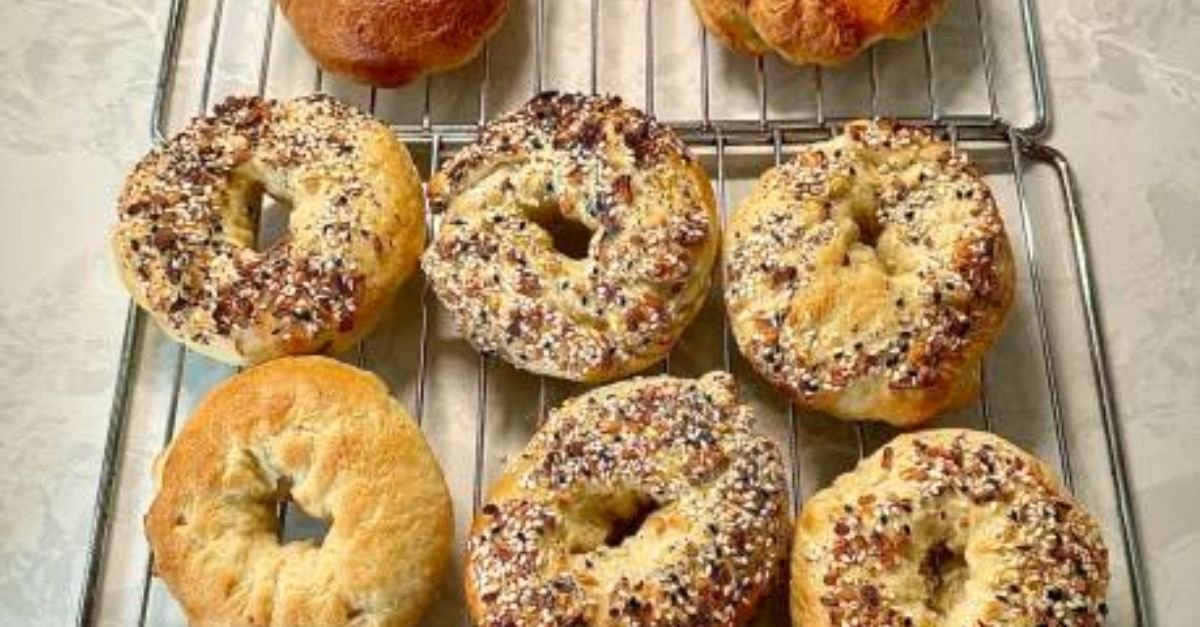
Transfer the baked bagels to a wire rack to cool completely. I know the smell is intoxicating, but cutting into a hot bagel can result in a gummy interior. Let them cool for at least 20-30 minutes to allow the crumb structure to set.
Chef’s Tips for Perfect Bagels
-
Bread Flour is Key: Do not substitute all-purpose flour. The high protein content in bread flour is what gives bagels their signature chewy texture.
-
Cold Discard is Fine: Using discard straight from the fridge helps keep the dough temperature down during mixing, which is ideal for yeast development.
-
Don’t Skip the Boil: This is non-negotiable. Boiling gelatinizes the starch on the outside, creating that thin, shiny, crispy crust. Without it, you just have round bread rolls.
-
Make Ahead: These bagels freeze beautifully. Slice them in half before freezing so you can pop them straight into the toaster.
Nutrition Information (Per Bagel, without toppings)
-
Calories: 285
-
Total Fat: 3.5g
-
Saturated Fat: 0.5g
-
-
Cholesterol: 0mg
-
Sodium: 440mg
-
Total Carbohydrate: 53g
-
Dietary Fiber: 2g
-
Total Sugars: 3g (Includes added sugars)
-
-
Protein: 9g