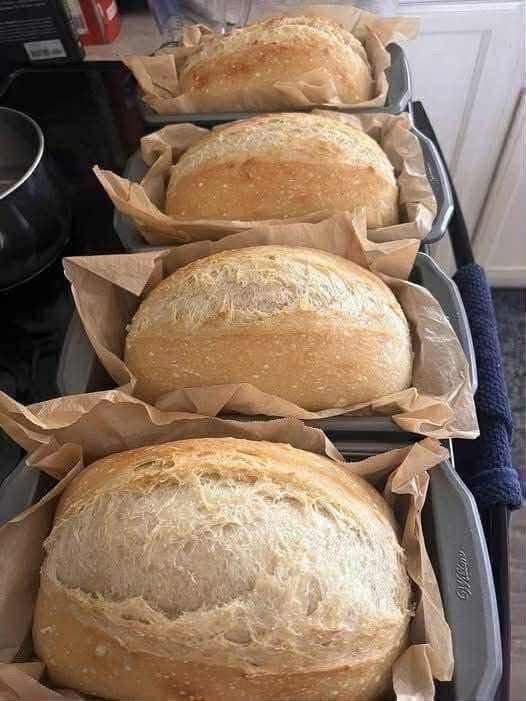
Prep Time: 30 minutes (plus overnight starter refresh)
Rise Time: 8-12 hours (primary) + 2-3 hours (final proof)
Bake Time: 40-45 minutes
Total Time: 11-15 hours (largely hands-off)
Yield: 1 beautiful loaf (about 20 slices)
Difficulty: ⭐⭐☆☆☆ (Medium – requires patience but simple techniques)
Intensity: Low hands-on effort, high flavor payoff.
Introduction
This is not just another bread recipe. This is your ticket to the most flavorful, aromatic, and satisfying sandwich bread you’ve ever made. Using a sourdough starter instead of commercial yeast creates a complex, slightly tangy flavor, a tender yet sturdy crumb perfect for holding fillings, and a golden, crackly crust. While the process spans a day, the active effort is minimal, making it a perfect weekend project that rewards you with a week of incredible toast and sandwiches.
Why You’ll Love This Recipe:
-
Superior Flavor & Texture: A depth of taste that store-bought bread can’t match.
-
No Commercial Yeast: Relies on your own sourdough starter for a natural rise.
-
Perfect for Sandwiches: The crumb is soft but structured, never crumbly.
-
Makes Your Kitchen Smell Amazing: The aroma of baking sourdough is pure comfort.
Ingredients
For the Levain (Pre-Ferment):
-
60g (1/4 cup) active, bubbly sourdough starter (100% hydration)
-
60g (1/2 cup) bread flour
-
60g (1/4 cup) lukewarm water
For the Main Dough:
-
All of the prepared levain (about 180g)
-
360g (3 cups) bread flour (plus extra for dusting)
-
50g (1/4 cup) whole wheat flour (for flavor and nutrition)
-
230g (1 cup) lukewarm water (adjust +/- 10g as needed)
-
9g (1 1/2 tsp) fine sea salt
-
25g (2 tbsp) honey or maple syrup (feeds the starter and enhances browning)
-
25g (2 tbsp) softened unsalted butter or olive oil (for a tender crumb)
Equipment:
-
9×5 inch loaf pan
-
Stand mixer with dough hook (optional, but helpful)
-
Large bowl
-
Bench scraper
-
Digital kitchen scale (highly recommended for accuracy)
-
Parchment paper (optional)
Step-by-Step Instructions
Step 1: Create the Levain (Night Before or Early Morning)
-
In a small jar or bowl, combine the 60g active starter, 60g bread flour, and 60g lukewarm water.
-
Mix thoroughly until no dry flour remains. Cover loosely and let it ferment at room temperature (70-75°F/21-24°C) for 6-8 hours, or until it has at least doubled in size, is very bubbly, and passes the “float test” (a small spoonful drops in a glass of water should float). This build ensures your starter is at peak strength for the dough.
Step 2: Mix the Dough (Morning)
-
Combine: In the bowl of a stand mixer or a large mixing bowl, add the water, honey, and all of the ripe levain. Whisk to disperse the levain.
-
Add Flours: Add the bread flour and whole wheat flour. Mix with the dough hook or a wooden spoon until a shaggy dough forms with no dry patches. Let this rest (autolyse) for 30 minutes. This allows the flour to fully hydrate and develops gluten naturally.
-
Knead: Add the salt and softened butter/oil to the bowl. Mix on medium-low speed for 6-8 minutes, or knead by hand on a lightly oiled surface for 10-12 minutes, until the dough is smooth, elastic, and passes the “windowpane test” (a small stretch of dough can be pulled thin enough to see light through without tearing).
Step 3: Bulk Fermentation (The Long Rise)
-
Place the dough in a lightly oiled bowl, cover with a damp cloth or airtight lid, and let it rise at room temperature for 8-12 hours. The time depends heavily on your kitchen’s temperature. The dough is ready when it has increased by about 50-75% (not necessarily doubled) and is puffy with bubbles visible at the edges.
Step 4: Shape & Final Proof
-
Preshape: Gently turn the dough out onto a lightly floured surface. Using a bench scraper, fold the edges into the center to form a rough rectangle. Let it rest, seam-side down, for 15 minutes (bench rest).
-
Shape for the Pan: Flatten the dough into a rectangle roughly the length of your loaf pan. Fold the long sides into the center, then roll it up tightly from one short end to the other, creating a tight log. Pinch the seam closed.
-
Pan Up: Place the shaped loaf seam-side down into a greased or parchment-lined 9×5 inch loaf pan. Press it down gently to fill the corners.
-
Final Rise: Cover the pan lightly with plastic wrap or a damp towel. Let it proof for 2-3 hours at room temperature, until the dough has risen just above the rim of the pan (about 1-1.5 inches above). It should spring back slowly when gently poked.
Step 5: Bake to Perfection
-
Preheat: About 30 minutes before baking, preheat your oven to 375°F (190°C) with a rack in the center position.
-
Score (Optional): Using a sharp knife or razor blade, make a shallow slash lengthwise down the center of the loaf. This controls expansion.
-
Bake: Bake for 40-45 minutes, until the crust is a deep, golden brown and the internal temperature reads 205-210°F (96-99°C) on an instant-read thermometer.
-
Cool: This is the hardest but most crucial step! Immediately remove the loaf from the pan and place it on a wire rack. Allow it to cool completely (at least 3-4 hours) before slicing. Cutting too soon traps steam and makes the crumb gummy.
Baker’s Notes & Tips for Success
-
Starter Health is Key: Your starter should be active and doubled within 4-8 hours of feeding. If it’s sluggish, do two feedings 12 hours apart before building the levain.
-
Temperature Matters: Cool kitchen (below 70°F/21°C)? Place the dough in your (off) oven with the light on for a slightly warmer spot. Warm kitchen? The rises will be faster.
-
Don’t Over-Proof: The loaf is over-proofed if it collapses or feels fragile before baking. If in doubt, it’s better to bake slightly under-proofed than over.
-
Storage: Keep the cooled loaf in a bread bag or wrapped in beeswax wrap at room temperature for up to 5 days. For longer storage, slice and freeze for up to 3 months. Toast slices straight from the freezer.
Nutrition Information
(Per slice, based on 20 slices per loaf)
-
Calories: ~115 kcal
-
Total Carbohydrates: 22g
-
Dietary Fiber: 1g
-
Sugars: 1.5g
-
Protein: 4g
-
Total Fat: 1.5g
-
Saturated Fat: 0.8g
-
Sodium: 180mg